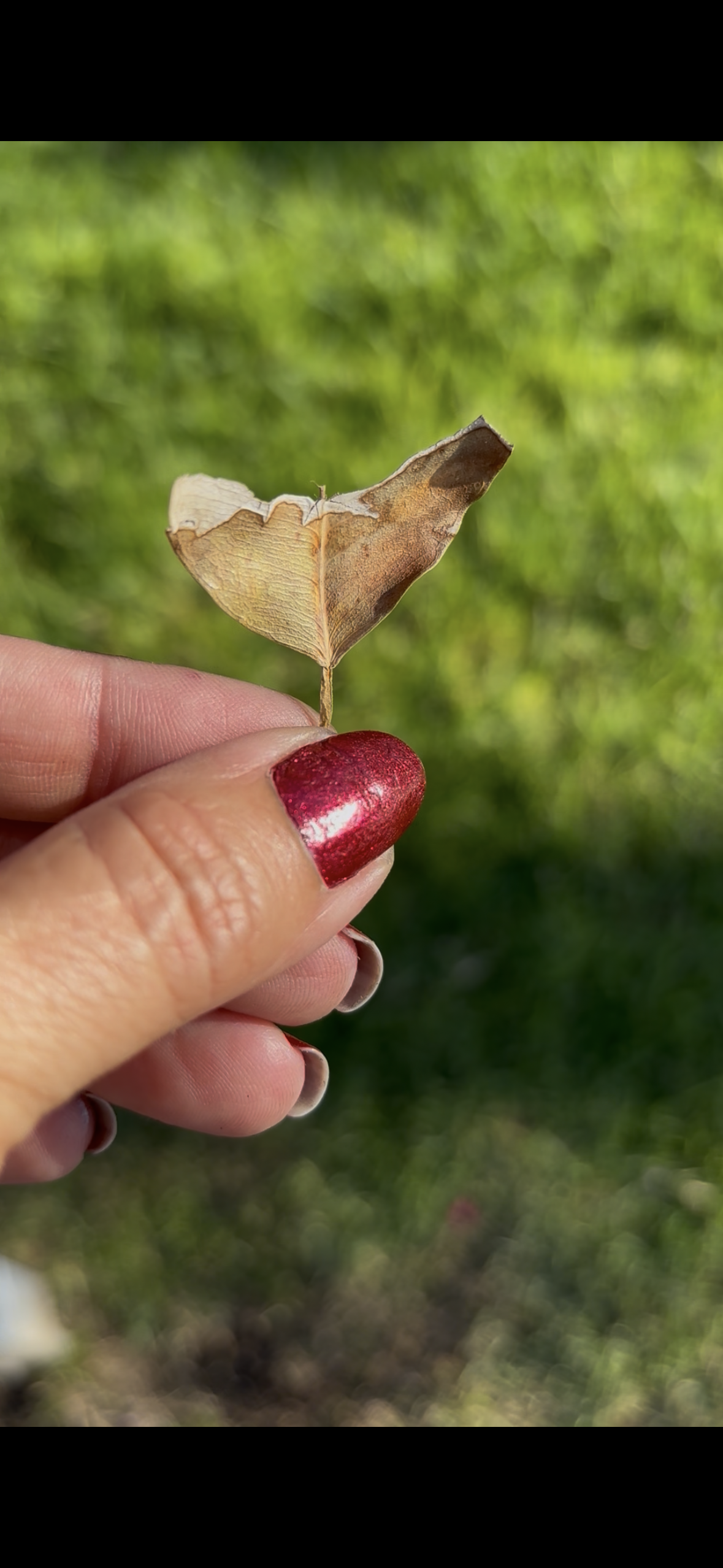
I see a mermaid’s tale. Tailing me.
Tell me a story.
*2 Once…
doce, trece, catorce, quince…
*2 Once… upon a time, there was a mermaid, in Spanish is called sirena.
And also -curiously- the siren of an ambulance is called sirena too.
Maybe because it makes sounds to alert, to wake people up, to remind us that someone needs attention, that everybody needs to stop, help, and give urgency the right of way.
3* Alerta. Aleta. Fin. The end…
finish your message, dear writer who plays with words like swords. Stop.
Nature shows its ways for us to be alert, focused, awake, present.

This little leaf, with its odd shape, made me imagine a Sirena singing her song, inviting me to put a fin on her tale. Maybe she wanted to go back to the sea to see her friends again.
Here on land, her sight became blurry, watery. Cataracts, the doctor said.
Then, she remembered the other sound and meaning of that word 4* catarata: a natural fall, full of water, nice view. Ironic. Iconic.
5* Oh Well. Here comes my dime for a wish. Dime tu deseo.
I want to see clear as a mermaid in the water.
I gave her the tail, and she gave me the tale.
And so she jumped into the 6* sé to sí, and she saw her cataratas away.
7* Seeing and sawing, here we go, interweaving tales and tails, just because this leaf came with its message. And one, and *tú must be alert to read it true.
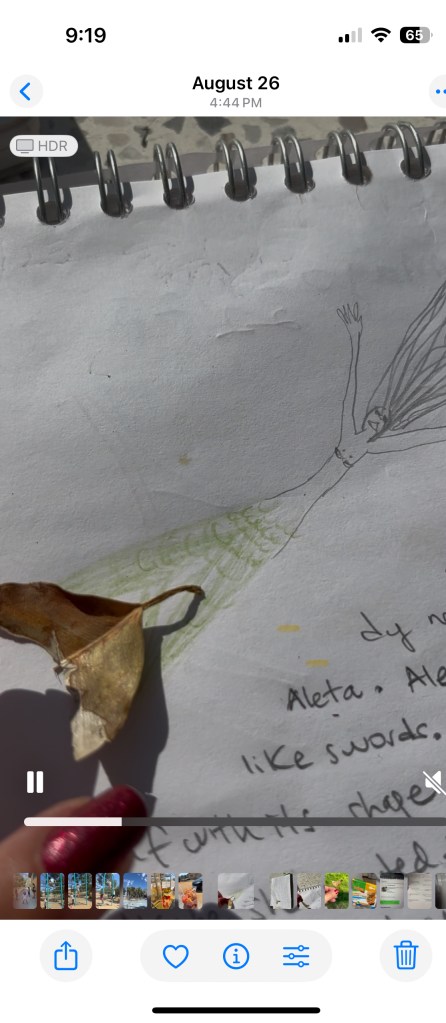
Tail me a story, little mermaid, and I’ll flow the current,
back to sea what I couldn’t see before.
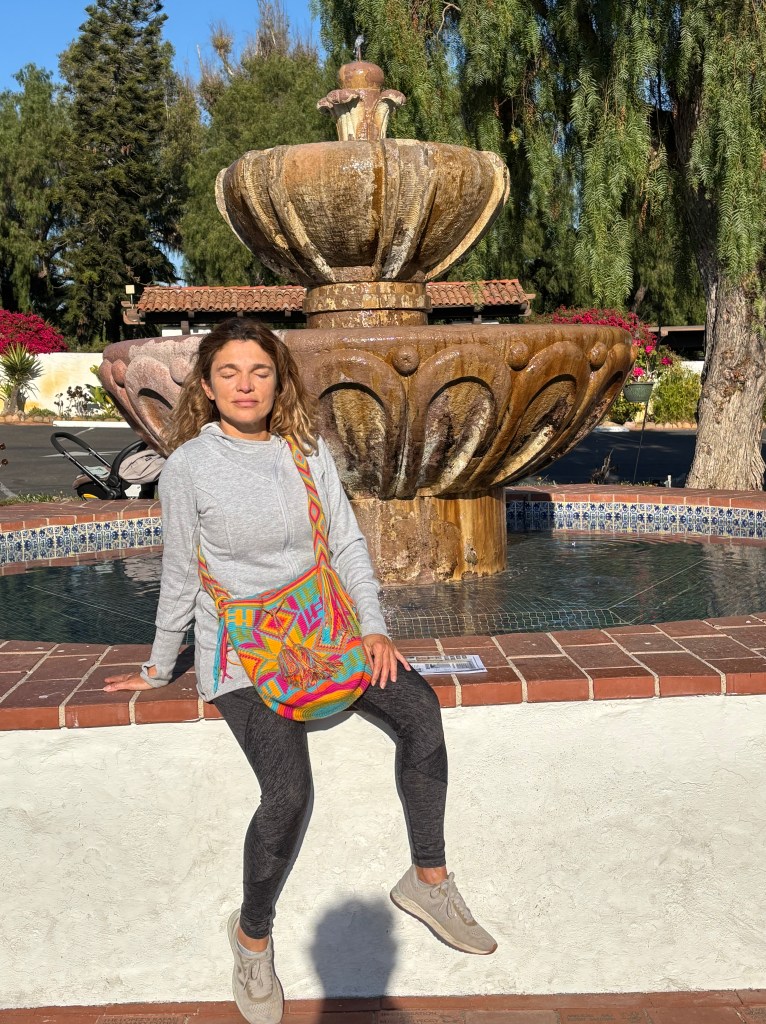
The artist’s creative notes:
This Spanglish piece is rich in soundplay, layered meanings, and bilingual joy. Translating it fully into Spanish requires creative adaptation, not just a word-for-word replacement.
I wrote the piece originally in English, where I played with rhyme, homophones, and double meanings across languages. In translating it, my goal was to preserve its playfulness, puns, and spirit. In some cases, English-Spanglish homophones had to be reimagined as new Spanish puns or imagery to keep the rhythm and meaning alive. (I will post my translation into Spanish very soon.)
At its core, this piece is about the mermaid and the writer, and their voices from the in-between, singing in hybrid tongues, slipping between sounds and meanings like water through fingers. The sirena showed up across borders, and so does the language of this story.
Here is my yarn in detail>
1* The words “tail”, “tale” and “tell” sound nearly identical in English. “Tail” refers to the physical tail of the siren: the symbol of her mystery, her otherness, her power.
“Tell” is the act of telling a story, and “tale”, the narrative.
2* Once: in English is used to begin a story, like in “Once upon a time.” But in Spanish, “once” just means the number 11.
In Spanish, the verb “contar” has a double meaning: it can mean to tell a story (contar un cuento), but it also means to count numbers (contar hasta quince: 15). So in Spanish, you can contar a fairytale or contar to ten, same word, different meanings.
3* “Alerta. Aleta. Fin.”
This triad plays with sound, rhythm, and layered meaning in Spanish:
- Alerta – Alert: a warning, a call to attention.
- Aleta – Fin: the fin of a fish or mermaid, signaling movement, escape, transformation.
- Fin – End: the conclusion of a story, or a life, a moment, a myth.
Phonetically and visually, the words are linked by their endings, and conceptually they move from awareness, to motion, to closure.
Together, they echo a mermaid’s arc:
She appears (alerta), flickers away (aleta), and disappears (fin).
And in a bilingual pun, “fin” is both “fin” (in Spanish) and “fin” (the fish fin in French and English), tying the imagery back to the sea.
4* “Catarata”: a natural wonder, a majestic waterfall: full of water, movement, and visual beauty. Iconic. A must-see. But in Spanish, “catarata” also names a visual impairment: the clouding of the eye’s lens that makes it hard or impossible to see.This double meaning is rich with irony:
You can’t see if you have cataratas, yet cataratas (waterfalls) are something people travel far to see. In this piece, “catarata” becomes a mirror:
- A symbol of what is meant to be seen,
- And what the body sometimes cannot see.
It’s iconic, a roadside landmark, demanding attention;
and ironic, because it speaks of vision in both its presence and its absence.
5* “Oh well. Here comes my dime for a wish. Dime tu deseo.”
This line plays with English-Spanish wordplay, irony, and layered meaning:
“Oh well” is a common English expression: a shrug, a sigh, acceptance: “It is what it is.”
But “well” is also the place where people toss a coin and make a wish; a wishing well.
So saying “Oh Well” becomes both an emotional release and a literal setting for a wish.
Then comes:
“Here comes my dime for a wish” a small coin, a small hope, tossed into that emotional/spiritual well.
Followed by:
“Dime tu deseo”: in Spanish, this means “Tell me your wish,”
but “dime” also sounds like “dime” (10 cents) in English.
So it’s a full bilingual wordplay:
- Dime (10¢) > tossed into a well (a place of hope),
- Dime (Spanish: tell me) > inviting someone else’s wish,
All wrapped in the expression “Oh well”, where hope and resignation meet.
6* This piece plays with the sounds and slippages between:
- Seeing – the act of looking, observing, perceiving.
- Sawing – cutting through something, usually wood; repetitive, physical, intentional.
- Sewing – stitching things together, mending, connecting.
And then there’s “saw”, the past tense of see, but also a tool (a saw), and a verb (to saw).
This overlapping creates a space where:
To see becomes to saw
perception becomes action.
And to sew is to stitch together what has been seen or cut apart.
The words sound alike, but do very different things. t’s a linguistic game, but also a meditation on how we observe, break, and repair the world or ourselves.
7* “And one, and tú must be alert to read it true.”
This line plays with sound, language, and meaning across English and Spanish, inviting you, the reader, into a bilingual riddle:
- “Tú” in Spanish means you (informal), but it sounds just like “two” in English;
so “tú” becomes both a person and a number.
In saying “and one, and tú”, the tale counts:
but also calls: it’s no longer just one, it’s two:
you, the reader, are now included.
Then: “read it true” which sounds like “read it through.”
To read through the text is to reach its true meaning.
8* “Sé to sí, and she saw her cataratas away.
Back to sea what I couldn’t see before.”
This fragment weaves together transformation, vision, and return; all through soundplay and bilingual meaning.
It begins with “sé to sí”: a shift from “sé” (I know) to “sí” (yes), signaling a movement from inner knowing to affirmation, from identity to consent. In this turning point, she sees her cataratas: both the physical waterfalls and the metaphorical clouds in her vision: begin to clear.
Then comes the return:
“Back to sea what I couldn’t see before.”
This line plays on the sound of the letter C, the verb to see, and the noun sea; blending them into one fluid, bilingual image.
- “Sea” and “see” are homophones in English; they sound the same but carry different meanings.
- The letter “C” shares the same sound, adding a visual pun: C / see / sea.
So the phrase becomes a layered return:
The mermaid goes back to the sea
to see what she couldn’t before,
to gain clarity, vision, perspective
like coming out of a fog, or waking from a spell.
The ocean becomes both a mirror and a threshold;
A place of truth, of memory, and revelation.
The irony becomes a poetic truth:
Sometimes you have to go back to the sea
to see
to truly “C”
what was always there, just out of view.
 Pat Lezama
Your spelling bee, has me all at sea! Magic! 🪄🔮
Thank you Ashley, you made my day :>)